Five names of Long Beach, as shown on historical maps of the area
By Guest Columnist Eddie Ware, Long Beach Historical Society
Although Long Beach is one of the youngest cities on the Mississippi Gulf Coast according to its incorporated age, its history dates back more than 250 years.
American Indians were, of course, the first inhabitants. No one really knows when they came to Mississippi, but there were at least fifteen tribes living in the state when the first Europeans arrived.
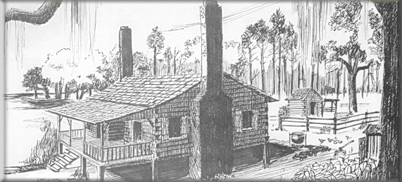
The Chimneys, home of Mr. and Mrs. Nicholas Ladner
- BEAR POINT
Years before Mississippi statehood, a small village on the Mexican Gulf was first seen as “Bear Point” on a 1774 British map. Perhaps the British took the name from Native Americans, or maybe they observed bears around the little bayou that runs through the area where the first Europeans would build. - CHIMNEY POINT
Nicholas and Marianne de L’Adner, originally from France, settled on Cat Island to begin raising a family. Forty-odd years later, after a violent hurricane, they moved to the mainland, around 1788, and built a home at the mouth of Bear Point Bayou, now Douglas Ave. Years after their deaths, the home burned, and only the chimneys on each end of it remained. They made good reference points for boaters, and another name was born and is shown as “Chimney Point” on the new Harrison County map of 1841. Locals called it “The Chimneys” or “Old Chimneys.” - ROSALIE
In the late 1840s, J McCaughan settled farther down on the bayou, next to a large live oak, built a home on the beach, which he named Rosalie, and allowed village mail to be dropped off by schooner at his pier. The village took on the name of his home, resulting in “Rosalie” listed on a 1865 coastal map and the 1860 census. - SCOTT’S STATION
With the advent of rail service in 1870, merchant and mill owner George Scott donated land and built a small building for a stop. The name “Scott’s Station” was a natural evolution from this act of generosity and is shown on Cram’s 1878 map as “Scott.” - LONG BEACH
In 1882, James and Woods Thomas bought property next to the McCaughans’ on the beach. They had the town platted and renamed Long Beach. This final name was chosen because of the long, sloping beaches of glistening white sand along the shoreline.
At its inception in 1961, the Carnival Association of Long Beach named its royalty King Scott and Queen Rosalie, perpetually honoring these two fine names from village history.