Public assistance sought to report whale shark sightings
Special to Long Beach Breeze
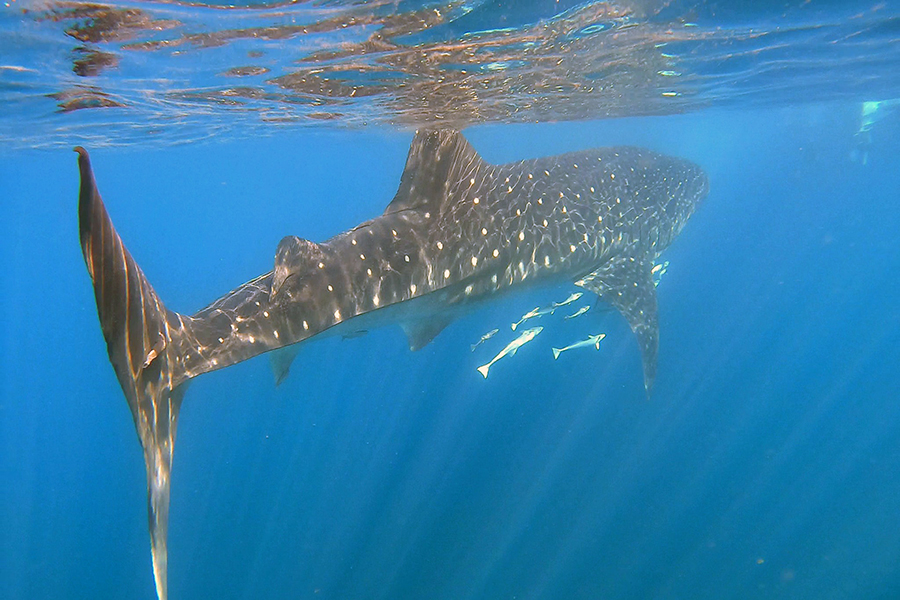
The University of Southern Mississippi (USM) Gulf Coast Research Laboratory (GCRL) is collaborating on a project to study whale sharks – currently listed as endangered by the International Union for the Conservation of Nature – and is asking the public to report any sightings in the Gulf.
Sightings of whale sharks in the Gulf have declined significantly since 2010. This decline has also been noticed at other large-aggregation sites in the western Atlantic region.
Researchers say they are unsure what is driving this change in the Gulf, which makes collecting data on whale sharks’ movements and habitat use even more critical. Potential causes include a population decline and/or a redistribution of the population, but more data is needed to identify the cause. Either way, they say the change is concerning.
Whale sharks are the world’s largest fish. They are currently listed as endangered by the International Union for the Conservation of Nature. The sharks eat plankton by filter feeding in surface waters, making them vulnerable to vessel strikes. Due to their large size, they are called “whale sharks,” though they are not whales at all. They have gills, which make them fish.
The Southern Miss GCRL relies on the public to report whale shark sightings, so that researchers can predictably find the animals to collect data on populations, animal size and sex, spot pattern identification, movements and behavior. Reports are needed immediately.
Sightings can be submitted using the online form located at https://usmforms.formstack.com/forms/whale_shark_sighting_survey.
For more information about USM’s whale shark and other marine research, visit www.usm.edu/fisheries-research-development.